
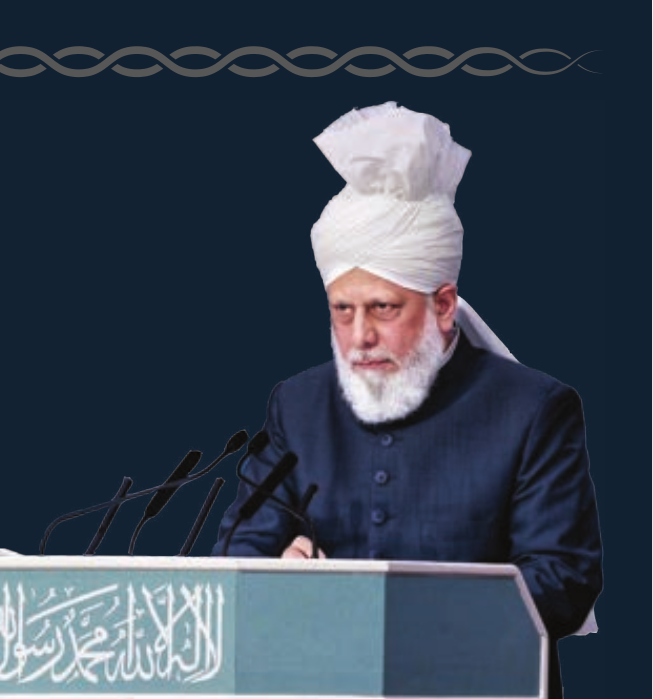
Friday Sermon delivered by
His Holiness Mirza Masroor Ahmad,
Khalifatul Masih V (aba) on Dec 5th, 2014.
The Holy Qur’an says:
‘O ye who believe! Obey Allah, and
obey His Messenger and those who are in authority over
you. And if you differ in anything among yourselves, refer it
to Allah and His Messenger if you are believers in Allah and
the Last Day. That is best and most commendable in the
end.’ (The Holy Qur’an 4:60)
This verse cites a principle for true believers to follow. That
is, they have to stress upon being obedient and have to
excel at it, be it obedience of God, His Messenger or of
those in authority. If those in authority or the government
directs you to do something which is against a clear
commandment of God and His Messenger, then the
commandment of God and His Messenger takes
precedence. However, if there is freedom of religion then
whether those in authority are Muslim or non-Muslim, they
are to be obeyed.
Hazrat Mirza Ghulam Ahmad, the Promised Messiah (on
whom be peace), said:
“The Holy Qur’an commands:
‘…obey Allah, and obey His Messenger and those who are
in authority over you…’ Here it is clearly commanded to
obey those in authority and it would be definitely incorrect
for someone to say that the government is not included in
‘those in authority over you’. Whatever the government
says in line with Shariah includes it in ‘those in authority over you’. Whoever does not oppose us is among us. It is
manifestly proven from the Holy Qur’an that the
government should be obeyed and whatever it says should
be accepted.’ (Journal Al Andaz, p. 69 – Tafseer Hazrat Masih
e Maud, Vol. II, p. 246))
A long extract from the writings of His Holiness Mirza
Ghulam Ahmad, the Promised Messiah, (on whom be
peace), was presented, which covered the points: what
should be the standards of obedience, the significance of
obedience, harm in not being obedient and the role
obedience played in the spread of Islam. In this current age
only Ahmadi Muslims can portray real obedience and can
demonstrate to the world how the dignity of Muslims can
be established. However, first and foremost we have to
raise our own standard of obedience.
The Promised Messiah (on whom be peace) wrote:
‘That is, obey Allah and His Messenger and your rulers. If obedience is adopted with sincerity the heart finds luminosity and the soul finds bliss and light. Spiritual exercise is not needed as much as obedience is needed, though obedience has to be sincere and that is the difficult aspect. It becomes necessary to crush your self-centredness in obedience because it is not possible to be obedient without this. And
self-centredness is an emotion that can create idols even in hearts of great big adherents of the Unity of God. How blessed were the Companions (may Allah be pleased with them) that they were a community wholly devoted in their obedience to the Holy Prophet (peace and blessings of Allah be on him). It is true that a community cannot be a community and cannot have the spirit of nationhood and
concord unless it adopts the principles of obedience. If differences of opinion and discord are prevalent, then consider these as signs of misfortune and decline. Along with various other reasons, mutual disagreements and internal conflicts are also behind the weak state and decline of Muslims. If a difference of opinion is abandoned and only one person is obeyed, whose obedience is commanded by Allah the Exalted, success is achieved in everything. The hand of Allah the Exalted is on the community; therein lies the secret.
Allah the Exalted likes oneness and unity cannot be established unless obedience is practiced. In the time of the Holy Prophet (peace and blessings of Allah be on him) the Companions were learned and had the ability to make judgments. God had thus created them that they were also well-versed in politics. The competence and excellence
with which Hazrat Abu Bakr (may Allah be pleased with him), Hazrat Umer (may Allah be pleased with him) and other Companions handled power when they became Khalifa demonstrates very well how capable they were at being learned with the ability to make judgments.
However, in the presence of the Holy Prophet (peace and blessings of Allah be on him), they considered naught all their opinions and discernment. Whatever the Holy Prophet (peace and blessings of Allah be on him) said, they deemed it worthy of practice. So devoted were they in his obedience that they sought blessing in the leftover water of his ablution and considered his blessed mouth venerable. If they did not have this spirit of obedience and compliance and everyone considered his own opinion the best, there would have been discord among them and they would not have attained high status.
In my opinion only one argument is sufficient to end the Shia and Sunni conflict, that is, the revered Companions did not have any kind of mutual discord or enmity. Their progress and advancement bore witness to the fact that they were as one and no one had any enmity with the other. Imprudent opponents say that Islam was spread with force but I say this is not correct. The fact is that their hearts were drenched with the spirit of obedience and it was a result of their obedience and unity that they won over hearts. My belief is that they only drew the sword in self-defence. Even if they had not drawn the sword they would have won over the world with their speech!
No doubt heartfelt words move the heart! The Companions accepted the truth with sincerity of heart and without any pretence. Their truth alone became the source of their success. It is right that a truthful person only uses the force of his truthfulness. The blessed countenance of the Holy Prophet (peace and blessings of Allah be on
him) effused the light of trust in God with both beauty and glory. It had attraction and power which drew hearts to it. And his community was exemplary in obedience of the Prophet and its stability proved to be so supremely auspicious that whoever saw it could not help but being drawn to it. In short there is a need now for the condition and unity of the Companions to be replicated. Because Allah the Exalted has joined the community which is being trained by the hands of the Promised Messiah to the community which was trained by the Holy Prophet (peace and blessings of Allah be on him). A community’s success is
borne of examples of such people alone, therefore those of you who are known as the community of the Promised Messiah and wish to be joined with the community of the Companions, instil the tenor of the Companions. Emulate their obedience; emulate their mutual love and unity. In short, adopt the ways of the Companions in every form.’ (Al Hakam, Vol. 5, dated 10 February 1901, pp. 1-6)
The Promised Messiah (on whom be peace) has elucidated many aspects in this extract. Firstly, he has explained obedience of God, His Messenger, your ruler and government. This includes the administration of the government as well as the administration of the Jama’at. Obedience of Khilafat precedes these two because Khilafat
establishes the commandments of God and His Messenger and the administration of the Jama’at works under Khilafat. It is the beauty of Khilafat that if ever there is a problem between those appointed to run the administration of the Jama’at and members of the Jama’at, the Khalifa of the time can remove it. Indeed, it is one of his duties to do so.
Obedience of Khilafat comes before obedience of government. However, there should be no misunderstanding in this regard because the Khalifa of the time is foremost in obeying the law of the land himself and in ensuring that others do too.
The Promised Messiah (on whom be peace) said in another place:
‘In worldly terms ‘ulul amr’ [who are in authority]means the king, and in spiritual terms it means the Imam of the age.’ (The Need for The Imam, p. 37)
Within the framework of the worldly system of government, a spiritual system can and does function. Fortunate are we to be part of this spiritual system. Khilafat endeavours to establish the kingdom of God and His Messenger in hearts and minds, and in situations of discord, the Khalifa reaches judgement according to the commandment of God and His Messenger. It is a favour of God that we have the system of Khilafat among us; otherwise, different sects and different jurists have
different views about matters. And rather than resolve issues, they can further entangle them. Similarly, different views can create different issues with the government as well. Thus interpretation of Islamic law over issues can only be achieved under Khilafat. Ahmadi Muslims could not be grateful enough for this, and this gratefulness can be expressed by showing complete obedience to Khilafat.
The Promised Messiah (on whom be peace) said something which is quite important:
‘If obedience is adopted with sincerity, the heart finds luminosity and the soul finds bliss and light.’
Certainly, here, obedience of the spiritual system is meant and this is also a way to measure your individual obedience. Do you experience the light and bliss mentioned here? Reflect over your own standard of obedience and assess it yourself as to how much obedience do you have for God, His Messenger and the Khilafat established by the Promised Messiah. Obedience of government brings peace and tranquillity but obedience of spiritual system brings peace and bliss. The Promised Messiah (on whom be peace) also said:
‘Spiritual exercise is not needed as much as obedience is need…’
without it, one cannot experience spiritual bliss and luminosity or peace in one’s life. People who feel very assured about their Salat and worship of God but do not practice obedience cannot be the recipients of God’s blessings. Another aspect of attaining a good standard of obedience as told by the Promised Messiah (on whom be peace) is:
‘It becomes necessary to crush your self-centredness in obedience…’.
One has to bring one’s wishes in line with what God and His Messenger said in order to be obedient. The Promised Messiah (on whom be peace) said that idols can be created even in the hearts of great big adherents of Unity of God which can make a person not even capable to obey on a very small level. The Promised Messiah (on whom be peace) said that the Companions (may Allah be pleased with them) only attained high standards of worship of God after practicing obedience.
Indeed, a Hadith relates that even if a slave of the lowest caste is your leader you have to obey him. In another version, it is stated that even if your leader has a low IQ you must obey him.
The Promised Messiah (on whom be peace) correlated national/communal advancement to obedience and said that a nation/community cannot be formed unless people adopt compliance and obedience for therein lies advancement. The Holy Prophet (peace and blessings of Allah be on him) said that advancement is in staying connected to one’s community, in listening to the discourses of Imam of the age and in obedience. If only the Muslim world was to understand this they would become a great force which no one on earth could contend with! We Ahmadis have to attain high standards of obedience. God has stated that obedience is most excellent for spiritual communities in terms of fruition. However, obedience demonstrates amazing results even in worldly communities.
We see in history that Napoleon took power in France when the country was in decline. He told the country that unless they gave up mutual discord, they would not progress and he advocated obedience in order to progress. The well-wishers of the country accepted his ethos and showed excellent obedience and compliance so much so that it is said it was a life-changing experience for Napoleon as well. After defeat in a big battle, he had to go into exile on an Italian island. When he returned to the shores of France, a new king was in power. The king had gathered priests, military commanders and politicians and taken their oath of allegiance on the Bible because he felt that Napoleon had such a devoted following that it could resurface upon his return. Napoleon gathered people upon his return although those loyal to him were not experienced soldiers. The king had sent a General with troops and they made a stand with Napoleon’s band at a very narrow pass. Napoleon ordered his men to go forward but they were killed by the government’s troops. He sent more men and they too were fired on and were killed. Seeing the situation Napoleon could not believe that his former troops would not obey him. He felt he had instilled obedience and loyalty in them. Assured of the loyalty he had once instilled in the nation he himself went forward and said: ‘Soldiers I am your Emperor. Know me! If there is one of you who would kill me, here I am.’ The soldiers could not bear this and they ran towards Napoleon. It is said some of them wept as they clamoured around Napoleon. The General also joined in offering his allegiance to Napoleon.
Hazrat Musleh Mau‘ud (may Allah be pleased with him) cited Napoleon’s return to power and said:
‘Napoleon or other leaders like him did not have the Divine help that true faith has yet they brought about revolutions. The situation of those who take Bai’at is different. Indeed, the very meaning and purport of Bai’at is to completely devote oneself with obedience. This meaning and purport is so lofty that obedience in worldly matters can never compete with it. The concept: ‘…obey Allah, and obey His Messenger and those who are in authority over you…’ is such that if a nation does not follow it, whether they are adherents of a true faith or are unaware of it, they cannot ever succeed.’
We should always keep the words of the Promised Messiah (on whom be peace) in mind that it is most important to have accord and obedience in order to become a nation or community. Without it there can only be decline and deterioration. The Holy Qur’an states in this regard:
‘And hold fast, all together, by the rope of Allah and be not divided; and remember the favour of Allah which He bestowed upon you when you were enemies and He united your hearts in love, so that by His grace you became as brothers; and you were on the brink of a pit of fire and He saved you from it. Thus does Allah explain to you His commandments that you may be guided’ (The Holy Qur’an 3:104).
It is most unfortunate that in spite of this clear Divine message Muslims have hit the lowest ebb of mutual discord and have forgotten their blessings and are at a terrible juncture in terms of calamity and decline. There has been a decline since the time of the Promised Messiah (on whom be peace) but now it has reached abysmal lows. The Promised Messiah (on whom be peace) said to give up your differences and obey one person, that is the Imam of the age, and then experience how everything you do will be blessed. Make God give them sense!
The Promised Messiah (on whom be peace) also said: ‘The hand of Allah the Exalted is on the community…’ and without this, success cannot be achieved and God cannot be found. God is found by those and only those have the correct insight and perception of Unity of God who have unity among them. We should not be simply pleased that we have taken Bai’at. We need to attain the standard of Bai’at which is, as clearly understood from the meanings of the very word Bai’at, to sell oneself.
The Promised Messiah (on whom be peace) explained by giving examples of Hazrat Abu Bakr (may Allah be pleased with him) and Hazrat Umer (may Allah be pleased with him) that they were learned and had the ability to make judgments and when the time was right these qualities of theirs shone brilliantly and they ran governments. However, during the lifetime of the Holy Prophet (peace and blessings of Allah be on him) it appeared as if they did not know anything. At the time they considered all their opinions and discernment as insignificant. And later the world witnessed how they guided the Companions and we see exemplary obedience during the period of Rightly-Guided Khilafat.
An incidence of the selflessness and discernment of Hazrat Abu Ubaida is that during a battle he received a letter from Hazrat Umer (may Allah be pleased with him) with the news of the passing away of Hazrat Abu Bakr (may Allah be pleased with him) and Hazrat Umer (may Allah be pleased with him) demoted Khalid bin Waleed and appointed Abu Ubaida the leader of the army. In light of wider national interest, Abu Ubaida did not inform Khalid bin Waleed of this until the treaty was not agreed with the people of Damascus. And he asked Khalid bin Waleed to sign the treaty. When Khalid bin Waleed came to know the facts, he expressed discontent, but Abu Ubaida made nothing of it and instead assured Khalid bin Waleed by mentioning his heroic achievements. Khalid bin Waleed demonstrated splendid obedience to Khilafat when he said: People! The ‘ameen’ of this Ummah has been appointed your leader. The Holy Prophet (peace and blessings of Allah be on him) had given Abu Ubaida the title of ‘ameen’ (trustworthy). Abu Ubaida said: I have heard the Holy Prophet (peace and blessings of Allah be on him) say that Khalid is one of the swords of God and is a most excellent young man of the tribe. Thus the order of the Khalifa of the time was cheerfully accepted.
Generally speaking, with the grace of God, the Jama’at has the spirit of obedience, but sometimes, if the odd person is removed from office, they ask why they have been removed, what they lacked, etc. If the historical examples/models are kept in view, such questions would never rise.
We should be mindful that today, it is the same Qur’an and the same Prophet (peace and blessings of Allah be on him) who is followed, but what is the condition of the Muslims? They are either embroiled in disorder, or they beg the world. The Promised Messiah (on whom be peace) said the Shia-Sunni discord is borne of abandoning obedience. What is needed is unity and especially the Promised Messiah (on whom be peace) has asked his Jama’at to instil the model of the Companions so that your truth can cut asunder the enemy. And this will come to pass when everyone of us will try and inculcate complete obedience and compliance. With absolute obedience of God and His Messenger we can also partake of the light which was granted to the Holy Prophet (peace and blessings of Allah be on him).
The responsibility on Ahmadis is very great; we have to demonstrate an example of ‘…obey Allah, and obey His Messenger and those who are in authority over you…’ which will draw the world to us. This is the only way we can take the world to the footsteps of God and His Messenger and can guide the world. This is the way we can end disorder in the world. We have the commandments of the Holy Qur’an which are worthy of being practiced and worthy of being obeyed. We have the blessed model of the Prophet and it is our obligation to obey it. And we also have the spiritual system of ‘ulul amr’ (who are in authority) over us which constantly draws our attention to the commandments of God and His Messenger. There is no reason we cannot generate a clear distinction between us and the others. May God enable all of us to do so, and may we always fulfill the expectations of the Promised Messiah (on whom be peace)!
Reference:
Taken from: https://www.alislam.org/friday-sermon/2014-12-05.html [Accessed: June 1, 2024]




Leave a Reply