
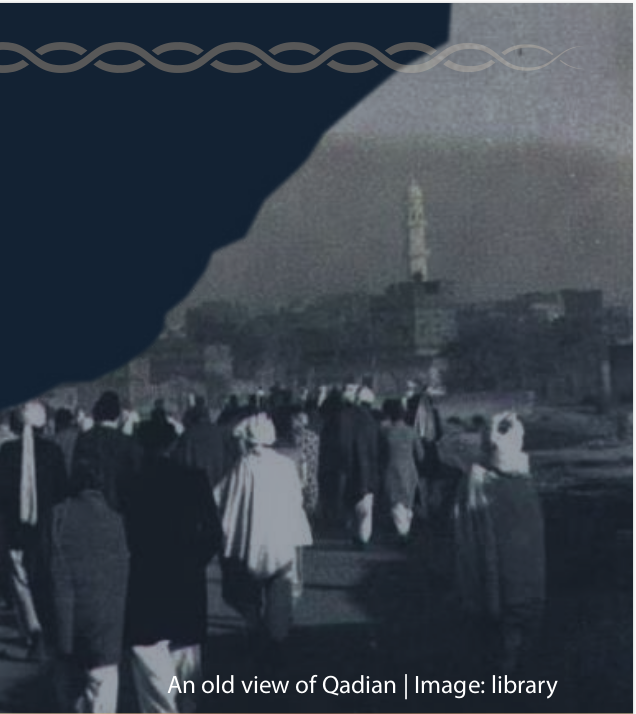
The Ahmadiyya Muslim Jalsa Salana or Ahmadiyya Muslim
Annual Convention started with divine guidance granted
to His Holiness Mirza Ghulam Ahmad (as), who is the
Promised Messiah and Mahdi for all religions.
Around the world we hold conventions relating to politics,
health benefits, scientific research, sporting events, and so
on. People benefit from these conventions to strengthen
their political affiliation and enhance their knowledge
about health and health benefits and their finances, while
scholars exchange ideas about their latest research. Most
of the conventions are dedicated to worldly or secular
learning, but it is spiritual uplift that is associated with the
Jalsa Salana of the Ahmadiyya Muslim Community, where
Ahmadi Muslims around the world gather to worship and
gain spiritual rewards and benefits.
In 1891, His Holiness Mirza Ghulam Ahmad, the Promised
Messiah and Mahdi (as), for the first time, called his
Community members to assemble in Qadian, India, during
the winter month of December. The purpose was to take
counsel of members who would act as judges in regard to
the first spiritual challenge the Promised Messiah (as) had
given to Muslim clerics in his book ‘The Heavenly Decree.’
That year, seventy-five companions traveled from far and
wide to Qadian on December 27, 1891. During the
congregation, respected Maulvi Sialkoti read out “The
Heavenly Decree,” and those present had the opportunity to shake the blessed hands of the Promised Messiah (as)
and benefitted from his company. This was the first Jalsa
Salana of the Ahmadiyya Muslim Community. On this
occasion, the Promised Messiah (as) announced that a Jalsa
Salana would be held in December every year (as during
winter months, farmers were not busy harvesting crops
due to holidays). The Promised Messiah (as) said: “Three
days of every year should be fixed for a gathering in which
all my devoted followers should – God willing, be present,
with the condition of health, time, and absence of strong
impediments. So, in my opinion, these dates should be
from the 27th to 29th of December. Hence, from this day,
December 30, 1891, if we live to see the 27th of December,
all our friends should, to the best of their ability, come and
listen to Divine words and join in supplication for the sake
of Allah” (1).
In an announcement on December 2, 1892, the Promised
Messiah (as) highlighted the extraordinary nature of the
Jalsa Salana:
“The primary purpose of this Convention is to
enable every sincere individual to personally experience
religious benefits; they may enhance their knowledge and
– due to their being blessed and enabled by Allah, The
Exalted – their perception [of Allah]may progress. Among
its secondary benefits is that this congregational meeting
together will promote mutual introduction among all
brothers, and it will strengthen the fraternal ties within this
Community……. It is essential for all those who can afford to undertake the journey that they must come to attend
this Convention, which embodies many blessed objectives.
They should disregard minor inconveniences in the cause
of Allah and His Prophet (sa). Allah yields rewards to sincere
people at every step of their way, and no labor and
hardship undertaken in His way ever goes to waste. I
re-emphasize that you must not rank this convention in the
same league as other ordinary human assemblies. This
phenomenon is based purely on the Divine Help, for
propagation of Islam” (2).
The total attendance at the first Jalsa Salana was
seventy-five devotees. The humble attendees came with a
profound love for the Promised Messiah (as), to be in his
company and to offer five daily prayers led by him; their
finances were meager, and traveling facilities were
inadequate and uncomfortable. Their accommodation
arrangements were made possible only through the most
exemplary sacrifices of His Holiness, Mirza Ghulam Ahmad
(as). It was not an easy task for the Promised Messiah (as),
yet he himself funded the Jalsa through whatever means
possible. His passion was such that he even asked his wife
(ra) to sell some of her jewelry to cover expenses; she did so
happily. The Promised Messiah (as) viewed the guests
arriving for Jalsa Salana as the guests of Allah. A narration
by Respected Munshi Zafar Ahmad Kapoorthalwi (ra)
highlights the initial financial challenges, the Promised
Messiah’s (as) passion for serving, and his trust in Allah and
the Divine help associated with the Jalsa Salana.
Respected Munshi Zafar Ahmad (ra) narrates:
“On one occasion, during Jalsa Salana, the funds diminished. In
those days, no formal Chanda fund (financial contribution)
was set up for Jalsa Salana’s expenses. Therefore, the
Promised Messiah (as) would bear the expenses himself.
Mir Nasir Nawab (ra) said there was no food for the Jalsa
guests. Upon this, the Promised Messiah (as) instructed,
‘take some jewelry from [my]respected wife that will
suffice for the need [of acquiring food for the guests], sell it,
and purchase whatever is needed.’ Accordingly, Mir Nasir
Nawab did so and purchased whatever was needed to
serve the guests. After two days, Mir Nasir Nawab, during
the night, while I too was present, informed the Promised
Messiah (as) that there was nothing left for the next day.
Upon hearing this, the Promised Messiah (as) said, ‘In
obedience [to God]we have exhausted all possible worldly
means, now we need not worry, the One whose guests
these are will Himself take care of them’” (3).
Respected Munshi Zafar Ahmad further goes on to narrate
that after the Promised Messiah (as) had said this, the very
next morning, at either 8.00 or 9.00 AM, when the postman came to deliver letters, the Promised Messiah (as) called
him and Mir Nasar Nawab. The postman was holding 10-15
money orders full of cash from Ahmadi Muslims who were
not able to attend the Jalsa Salana. They had written a note
along with the cash saying that they could not travel to
Jalsa Salana for various reasons; however, they were
sending money to aid with the care of the Jalsa guests. The
Promised Messiah (as) immediately delivered a short
speech about trust in Almighty Allah. He explained that a
worldly person relies upon the money in his savings box
and trusts he can use it whenever he so wills. However,
those who trust Allah and believe in Him have a stronger
conviction and trust than a worldly person’s confidence in
his savings. And it is so whenever they are in need, God
Almighty instantly provides for them. (3)
The second Jalsa Salana of 1892 became known as “the big
Jalsa” among those attending. The history of the
Ahmadiyya Muslim Community (1) describes how this Jalsa
was held next to the pond in Qadian. The stage was built
from mud collected in and around the pond. The Promised
Messiah (as) sat on a raised platform on which a carpet had
been laid, and Jama’at members were seated around him
on the ground.
The historical proceedings of the second Jalsa Salana, on
December 27, 1892, was the first speech delivered by His
Holiness Maulana Nooruddin (ra) on the death of Jesus.
Thereafter, respected Syed Hamid Shah (ra) recited a
Qasida before the audience. Then, the Promised Messiah
(as) delivered a powerful lecture regarding a section of his
book, ‘Tauze-e-Maram’ (Elucidation of Objectives), that
dealt with angels; Muslim clerics had raised objections
against it. The speech had a profound effect on those
present. The Promised Messiah (as) later also conversed
with his companions after the prayers of Zuhr and Asr (mid
and late afternoon). On the second day, 28th December
1892, a Majlis-e-Shura (consultative/advisory council) was
held to discuss plans for Tabligh (propagation) across
Europe and America – approximately 40 prominent
companions contributed and presented their ideas. The
gathering decided to create a detailed leaflet portraying
the beautiful teachings of Islam and distribute it for free in
Europe and America. This was the beginning of “The
Review of Religions” magazine. Counsel was also taken on
building a press desk in Qadian, a list of those companions
was also recorded who would financially contribute to this
project. Another proposal concerned the initiation of a
newspaper that would aid in spreading the teachings of
Islam Ahmadiyyat. Maulana Syed Muhammad Ahsan
Amrouhi (ra) was made responsible for promoting this
proposal across India. The aims and purpose of Jalsa Salana were discussed by Majlis-e-Shura and its organization was
given structure; a committee was proposed that would
take care of arranging future Jalsa Salanas (Annual
Conventions). The proposal presented that His Holiness
Maulana Noorudin (ra) be made in charge (3).
The Jalsa Salana, the Divine Annual Convention, started by
the Promised Messiah (as) in 1891, is still being held
worldwide. First in Qadian, after the partition of the Indian
subcontinent in 1947, the Ahmadiyya Muslim Community
grew in number, and Jalsa Salana continued to be held in
the small town of Rabwah. The Jalsa Salana steadily
increased in size and influence as even more Ahmadi
Muslims gathered to enhance their spiritual knowledge
and reaffirm their dedication to their Khalifa. In 1973, the
third successor to the Promised Messiah (as), His Holiness
Mirza Nasir Ahmad (rh), allowed foreign delegates to
attend Jalsa Salana. With this, the Jalsa Salana became the
gathering of nations or international Jalsa Salana. In 1984,
the government of Pakistan, through an ordinance, denied
Ahmadi Muslims the right to practice their faith. Due to
these circumstances, the fourth successor to the Promised
Messiah (as), His Holiness Mirza Tahir Ahmad (rh), left
Pakistan and migrated to the United Kingdom, moving the
headquarters to Fazl Mosque in London. The last Jalsa
Salana held in Rabwah in December 1983 was attended by
over 250,000 faithful Ahmadi Muslims in the presence of
their beloved Khalifa in Pakistan for the last time.
Meanwhile, under the guidance of Khilafat, the
Community was spreading worldwide. Countries such as
Ghana, Nigeria, Germany, Switzerland, Canada, the United
States of America, Fiji, Bangladesh, Australia, Singapore,
and many more held their own separate Jalsas and
continue to do so yearly. The highlight of the Jalsa Salanas
is the addresses of the Khalifatul Masih in person or
whenever possible through Muslim Television Ahmadiyya
(MTA), the Community’s satellite TV network and it is
streamed live on the internet.
Today, the Jalsa Salana’s organizational structure can
handle everything from setting up the venue to obtaining
the necessary legal clearances for the event, preparing a
comprehensive three-day program, and arranging
accommodation, food, and transportation for thousands of
guests who arrive from many countries worldwide.
The organizational structure of the Jalsa Salana works
under the leadership of Afsar Jalsa Salana
(Officer-In-Charge Jalsa Salana), with different Nazims
(Directors) taking care of all the Departments. In some
countries, the Afsar Jalsa Salana works all year, preparing
for three days in December or sometimes three days according to their calendar. The Jalsa Salana program
traditionally starts with the raising of the
Lawa-e-Ahmadiyya (the official flag of the Ahmadiyya
Muslim Community) and silent prayer a little after the
Jumuah (Friday) service, marking the beginning of the first
day’s proceedings. Friday’s sermon, delivered by His
Holiness Khalifatul Masih (aba), starts the first session. The
three days of Jalsa Salana are split into six short sessions
containing almost a dozen speeches on various religious
subjects, richly enlightening the audience. On the second
day, at the International Jalsa Salana UK or where Khalifatul
Masih is in attendance, in the morning, His Holiness
delivers an address in person to the women of the
Community and their guests, and in the afternoon,
local/national dignitaries and other religious leaders who
share equally in their vision of universal compassion and
inter-religious harmony, deliver their short discourses. This
is followed by a comprehensive annual report of the
worldwide Ahmadiyya Muslim Community’s efforts in
various fields, delivered by His Holiness. The third day’s
highlight is the concluding address of His Holiness, the
Khalifatul Masih (aba), or by the Amir (National President)
of that country where the Khalifatul Masih (aba) is not
physically present. During these three days of Jalsa,
exhibitions are arranged, ranging from Tabligh, Books of
the Ahmadiyya Muslim Community, Majlis Khuddamul
Ahmadiyya (male youth auxiliary) booth, and MTA (Muslim
Television Ahmadiyya) booth, as well as booths for
homeopathy services and Department of Matrimonial
Affairs services.
Jalsa Salana concludes with a silent prayer led by His
Holiness (aba) or by the Amir of the country. After the silent
prayers at the International Jalsa Salana UK, selected
groups of reciters representing various cultures are given a
few moments to present emotional poems expressing
their unwavering love for Khilafat, where Khalifatul Masih is
physically present. As the last group finishes, His Holiness
waves his hand to the impassioned audience present and
those on the other side of the globe, signaling his farewell
for that year’s Convention. In reply to it, thousands of hands
instantly arise across the enormous seating area, intensely
waving back with tears of gratitude. Indeed, this is the
unique spiritual experience of meeting fellow Ahmadi
Muslims, and non-Muslim attendees. May this divine
convention continue satiating the love of devoted Ahmadi
Muslims and enhance their connection with humans from
every walk of life from different cultural and ethnic
backgrounds, creating an atmosphere of harmony and
bridging all differences.
References
- Mirza Ghulam Ahmad (as), The Heavenly Decree, Islam International Publications Ltd., 2006, pp. 74 -75
- Al Hakam, Friday, August 3, 2018, Issue XX, p. 16 [Accessed May 12, 2024:
https://www.alhakam.org/print_edition/al-hakam-jalsa-salana-special-03-august-2018/%5D - Tarikh-e-Ahmadiyyat, vol. 1, pp. 444 – 448



Leave a Reply