
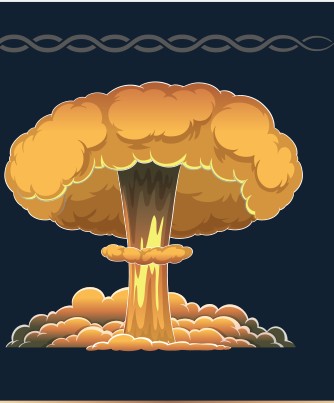
When the Holy Qur’an makes a prophecy, people often expect the sign to be so clear that no element of faith is left at all. However, the Founder of the Ahmadiyya Muslim Community and Promised Messiah (as) explained the purpose of a sign in religion:
“A Sign is not something so openly self-evident that the entire world is obliged to accept it without any disagreement, excuse, or hesitation; and no one, regardless of his disposition, is left with any doubt about it, and even the dullest of the dullest men accepts it without a qualm.
“A Sign or a miracle, therefore, is not a self-evident phenomenon for men of every disposition so that it should be accepted as soon as it is witnessed; rather, the fact is that only the wise, just, righteous, and truthful people derive benefit from Signs.”
(Bahrain-e-Ahmadiyya, vol. 5, p. 62)
This is important to remember when studying Qur’anic prophecies. The chapter we will look at is Al-Humazah, which contains specific
indications of nuclear war.
The Fourth Khalifa of the Ahmadiyya Muslim Community explained how nuclear war is prophesied by this chapter in his book Revelation, Rationality, Knowledge, and Truth. In this essay, I will take the same central point that this chapter of the Holy Qur’an addresses, namely nuclear war, and explain it from a different angle.
The verses under comment state about wrongdoers:
“Nay, he shall surely be cast into ‘Al-Hutamah’. And what should make you know what the ‘Al-Hutamah’ is. It is Allah’s kindled fire, which will leap at hearts. It will be enclosed against them.”
(Al-Humazah 104:5-9)
Fire Ignited from Fission
The word “Al-Hutamah” is significant in this chapter because these verses could otherwise have been much shorter without it. The Holy Qur’an is a concise book, and its general style is characterized by brevity. Here, the Holy Qur’an could have simply said, “Nay, he shall surely be cast into Allah’s kindled fire.” The fact that so many additional words are used to emphasize “Al-Hutamah” shows the importance of this word in describing the kindling of that fire.
The root of this word means, “It broke, or became broken, in pieces,” and “Al-Hutamah” means “that which breaks in pieces.” [1] The English word “fission” has a very similar meaning: “a splitting or breaking up into parts.” [2]
Interestingly, the word “Al-Hutamah” is not used to describe fire in Arabic. One linguist writes, “This word, “Hutamah,” describes Hell as one of the terminologies of the Qur’an, but in Arabic speech, this word does not describe fire.” [3]
Thus, the Holy Quran used a word that was not used for fire to describe the kindling of a specific fire. It says this fire is “kindled” as a result of “breaking into pieces,” like the fiery explosion that results from nuclear fission.
A nuclear explosion starts when a neutron strikes an atom of a heavy atomic nucleus [like Uranium], causing it to split and release energy and more neutrons. These neutrons then strike more atoms’ nuclei and split them, releasing even more energy and more neutrons [chain reaction]. This continues in an uncontrolled nuclear fission reaction, which is called an atomic explosion.
The description of this fire in the Holy Qur’an could not have been understood literally by people at the time it was revealed; however, we can now see that it uniquely describes how a nuclear explosion occurs.
Leaping at Internal Organs
The Holy Qur’an then says this fire “will leap at hearts.” The word for “hearts” used here is “af’idah.” The word “af’idah” is synonymous with another word used for hearts in the Holy Qur’an, which is “qulūb.” When contrasted, the word “qulūb” refers specifically to hearts only,
whereas the word “af’idah” refers to hearts and the organs around it,
like the lungs and liver. [4] Thus, the verse says this fire will directly strike vital internal organs.
Unlike conventional fire, nuclear explosions cause injuries to internal organs rather than external burns alone. The shockwave, shrapnel and debris, and radiation do more damage through internal injuries.
Radiation burns have been described as looking like a
“three-dimensional sunburn.” [5]
This is another characteristic of fire that was foreign to the people at the time it was revealed. Conventional fire burns the outside first, but the specific fire described here attacks the internal organs directly.
Enclosed Critical Density
Next, the Holy Qur’an says, “It will be enclosed against them.” The word for “enclosed” is “mu’sadah,” which has the root meaning of “closing,” as with an entrance, or “covering,” as with a cooking pot. [6]
This is another characteristic of fire that was foreign to the people at the time it was revealed. Conventional fire will be extinguished when it is enclosed because its supply of oxygen is depleted. However, this fire is enclosed yet active.
For a nuclear explosion to occur, a mass of nuclear material must be held together under intense pressure. [7] If the core blows itself apart before the chain reaction can achieve its full potential, a fizzle occurs. [8] Inefficient bombs only utilize a small percentage of their fissile material before they explode, wasting the rest. A bomb that uses the maximum percentage of its fissile material is considered efficient. The effectiveness of the compression [9] and the efficiency of the rate of fission [10] directly relate to the weapon’s yield.
The description in the Holy Qur’an of this fire being “enclosed against them” is not descriptive of ordinary fire, but is a necessary characteristic of a nuclear bomb.
Conclusion
All these descriptions of the fire in this chapter of the Holy Qur’an indicate a nuclear explosion. The Fourth Khalifa of the Ahmadiyya Muslim Community wrote about this chapter:
“Among the Qur’anic prophecies relating to events and inventions of our age, there are some which are of outstanding importance and great global significance. One such prophecy relates to the impending danger of a nuclear holocaust. This prophecy was made at a time when man could not entertain the idea of an atomic explosion by any stretch of his imagination.” [11]
This chapter carries a prophecy of the devastating destruction destined for our time. However, only wise, just, righteous, and truthful people can understand and then save themselves from the punishment that we are warned of in this chapter.
References:
- Lane’s Lexicon
- Merriam Webster
- Tafsir Ibn Ashur
- Lane’s Lexicon
- https://en.wikipedia.org/wiki/Louis_Slotin#Slotin’s_death
- Lane’s Lexicon
- https://en.wikipedia.org/wiki/Nuclear_chain_reaction#Nuclear_weapons
- https://en.wikipedia.org/wiki/Nuclear_weapon_yield#Yield_efficiency
- https://en.wikipedia.org/wiki/Nuclear_weapon_design#Implosion-type
- https://en.wikipedia.org/wiki/Boosted_fission_weapon
- Revelation, Rationality, Knowledge and Truth, p. 613


Leave a Reply